What Is a Data Science Agent? How AI Agents Are Transforming Data Workflows
Recent Posts
Data Science Meets the Agentic Era
Across functions, value-added AI systems no longer just assist, they act. These AI agents operate with context awareness, autonomy, and goal-driven reasoning. Instead of simply responding to commands, they decide how to achieve the user’s desired end goal. To do this successfully, agents need access to deep business context.
Enter: the Data Science Agent. It lies at the intersection of AI, data, and decision-making, changing the way humans approach data science and the way agentic workflows can use predictive models to better execute users’ goals.
What Is a Data Science Agent?
A Data Science Agent is an intelligent system that helps users navigate the entire data-to-decision lifecycle, from data exploration, feature creation and model training to deployment and monitoring, with minimal manual intervention.
A holistic Data Science Agent understands your intent, context, and data environment, then acts to:
- Explore and understand the source data.
- Generate and validate features automatically.
- Select and train models with appropriate parameters.
- Evaluate performance, interpret results, and recommend improvements.
- Deploy models or export logic to production seamlessly.
In short, it acts like a collaborative AI teammate for data scientists and ML engineers — combining automation, reasoning, and adaptability. Data Science Agents also work as part of broader agentic AI workflows, supplying other agents with the deep business context they need to make smarter, more human-like decisions.
How Today’s Data Science Agents Work
The first wave of Data Science Agents is already here, embedded in familiar tools:
| Platform | Automation Level | Agentic Capability | Limitations |
| Google Colab | Task-level automation (individual workflows like EDA, training) | Code generator for notebook workflows; responds to natural language prompts | Notebook-scoped only; limited data sources; no production deployment |
| Snowflake | Workflow-level automation (multi-step ML pipelines) | Plans and generates executable ML pipelines with reasoning | Platform lock-in; preview/early access status; Snowflake cost constraints; limited contextual guidance |
| Databricks | Assisted automation (iterative code generation and execution) | Plans workflows, generates code, executes iteratively based on outputs | Beta feature; workspace prerequisites; quota/stability limits; ecosystem dependent |
These tools represent major steps toward agentic data workflows — but they tend to focus on assistance within one phase (coding, modeling, or deployment), not the entire lifecycle. They act like code generation tools for data scientists, where the expectation is that the user knows the data, problem and domain deeply.
FeatureByte: The Data Science Agent for the End-to-End AI Lifecycle
FeatureByte takes the concept of a Data Science Agent to the next level. Instead of acting just as an assistant, it’s an ideation and decision-making engine that unifies each step of the data science lifecycle into one cohesive system that facilitates rapid experimentation and productionization.
Here’s how FeatureByte is different from other Data Science Agents:
1. Intent-Aware Automation
Instead of waiting for code prompts, FeatureByte interprets what you’re trying to achieve (e.g., “predict which customers are likely to churn in the next 3 months”) and automatically proposes domain-relevant features, templates, and validation strategies based on the data.
2. Human + Agent Collaboration
FeatureByte’s design philosophy is modular. Whether you want full autonomy or guided control, you can decide how much power to delegate to the platform. FeatureByte helps generate ideas, refine logic, or even fully automate the entire end-to-end data science lifecycle, all while keeping the user in the loop.
3. Lifecycle-Oriented Agentic Design
FeatureByte transforms raw data into deep business context, closing the loop to:
- Create features
- Train and evaluate models
- Refit, compare, and deploy
- Govern and monitor
While other tools focus on just one step in the process, FeatureByte automates the whole lifecycle. It’s not a coding assistant, it’s a member of the data science team.
4. Native Platform Intelligence
Unlike notebook-based agents that live “outside” your data platform, FeatureByte executes natively within Snowflake, Databricks, BigQuery, or Spark — avoiding data movement and maintaining security and performance.
5. Speed without Sacrifice
FeatureByte examines thousands of features and produces full feature lists, a process that normally takes months to build manually, even by the most expert data scientist. The Data Science Agent doesn’t take a brute force approach; instead, it follows the same process that a seasoned data scientist would use to build features.
How a Data Science Agent Transforms Agentic Workflows
Let’s look at an example of how deep context delivered by FeatureByte’s Data Science Agent transforms an agentic workflow.
A large B2C enterprise is building an agentic workflow for customer retention. The agents in the workflow work together to follow 5 steps:
- Deliver the offer to the customer
- Identify the customer’s churn risk
- Decide whether the customer should be handed off to a Customer Service Representative
- Select which offer to send to the customer to prevent churn
- Personalize the offer so that the customer is likely to accept it
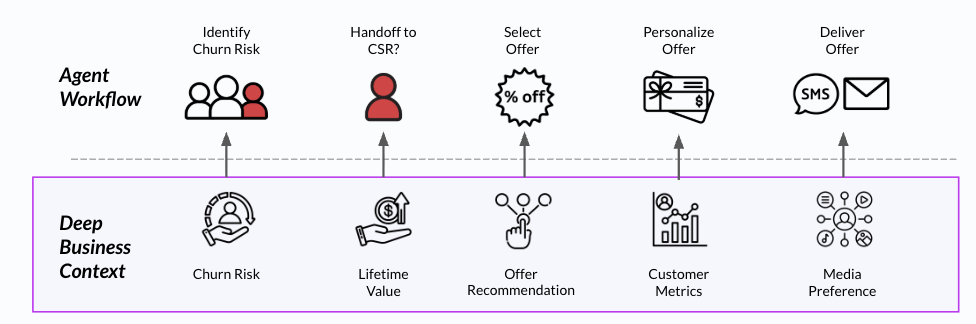
At each step, predictive models built by FeatureByte’s Data Science Agent inform the workflow with the deep context it needs to make smarter decisions:
- Accurately predict customer churn likelihood
- Predict customer lifetime value: helps the workflow properly route high-value customers to human representatives
- Predict which offer will resonate: uses customer behavior history to recommend an offer that the customer is most likely to accept
- Personalize the offer with customer context: tweaks the offer based on known preferences and metrics, tailoring the offer specifically to the customer
- Select the right delivery method: predicts which delivery method (text, email, etc.) the customer is most likely to respond to
Without the Data Science Agent, the agent workflow can still make decisions, but they are neither intelligent nor optimized. By infusing deep business context at every step, the customer retention workflow can deliver offers that are highly personalized and likely to convert to every customer.
The Future: Collaborative Intelligence Between Humans and Agents
In the near future, Data Science Agents will:
- More deeply understand business context and data context.
- Explain the steps they take in plain English, allowing the process to be transparent for data scientists and easily explainable to business stakeholders.
- Collaborate seamlessly across human teams and agentic workflows, democratizing access to advanced ML capabilities.
FeatureByte sits at this frontier: enabling a world where AI doesn’t replace data scientists but amplifies them, transforming expertise into reusable, automated intelligence.
Explore more posts